Financial Advisory provided the best combination that met Jimmy’s needs
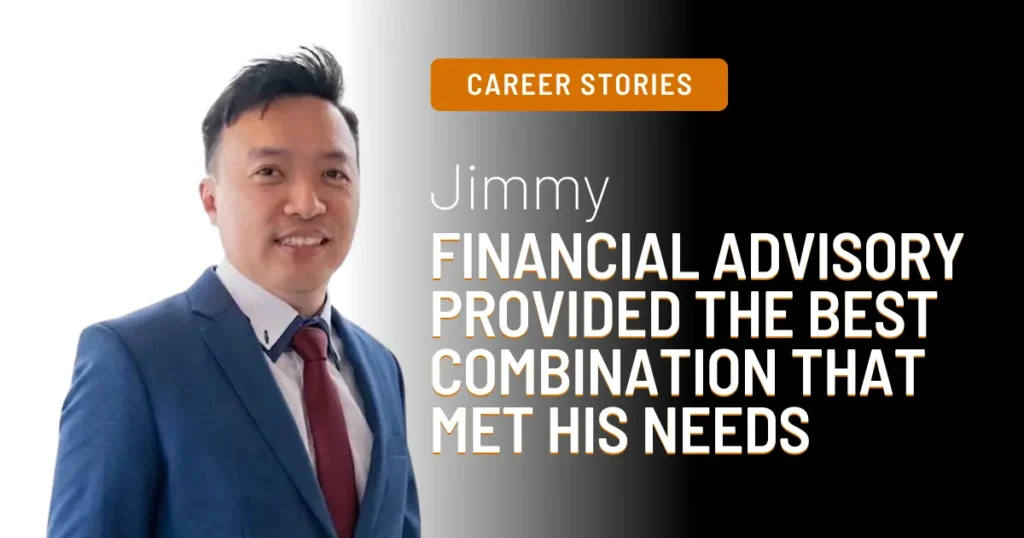
For the first six years of his career, Jimmy followed a path many would admire. After graduating from polytechnic, he entered the technology sector as a software engineer in a telecommunications company. While working full-time, he continued upgrading himself academically and eventually earned a Computer Science degree through studies supported by Ngee Ann Kongsi.
He later moved into a government-linked statutory board environment, working in security-related systems under Singapore Police Force, including projects connected to high-level operations.
On paper, Jimmy was doing well. He had a solid technical background, a respected career, and growing experience in a field many people considered future-proof. But Jimmy noticed something others ignored. The industry was changing quickly.
As new enterprise systems were introduced, specialists from overseas were being hired for increasingly complex software work. Jimmy saw how deeply skilled some of these experts were. They lived and breathed coding, constantly sharpening their craft, often spending every waking hour immersed in technology.

He respected them. But he also recognised an uncomfortable truth.
If he continued on the same path, he would eventually be competing in a game where others had both the advantage of specialisation and relentless focus. He knew he needed to evolve — not because he lacked ability, but because he wanted to remain relevant.
That moment of honesty became the turning point of his life. Around the same time, Jimmy read Secrets of the Millionaire Mind. The book challenged the way he thought about money, success, and opportunity. For the first time, he realised that many of his beliefs were rooted in a scarcity mindset.
“I had what people call a poor man’s mindset,” he admitted.
That realisation hit hard. Instead of ignoring it, Jimmy acted on it. He reached out to a friend who was already in the financial advisory industry and asked a direct question:
“How do I change my mindset?”
His friend introduced him to a senior leader in the industry, who later connected him with Chris. That introduction would change the course of Jimmy’s future. At first, the move was not obvious. Why would a trained engineer with a degree and stable career walk into an industry known for uncertainty, rejection, and commission-based income?
Because Jimmy saw something most people miss.
He realised financial advisory was not merely a sales job. It was a business where effort could directly shape income. It was a profession where flexibility existed. It was a path where strong relationships mattered. And unlike many traditional careers, there was room to grow without waiting years for permission.
He began in the industry in December 2010, first under IPPFA before later moving to Financial Alliance with Chris and the team. More than a decade later, he has never regretted the decision.
“There’s no other job that gives you income potential, flexibility, and the chance to travel the same way,” he said.
But what Jimmy values most is something simpler. He no longer drags himself to work. His days revolve around meeting people, having real conversations, understanding concerns, and helping clients make clearer decisions. To him, success in this profession is not about pressuring people into products.
It is about empathy. He believes every recommendation should pass one important test:
If I were in their shoes, would I do this myself?

That principle gives him conviction. If he cannot believe in the plan personally, he will not recommend it. Jimmy is also quick to challenge one of the biggest myths about the profession — that only extroverts or “natural salespeople” can succeed. Many people say they are not a people person. Many assume they do not know how to sell. Jimmy sees it differently.
This business is not about forcing deals or memorising scripts. It is about being pleasant, trustworthy, and genuinely interested in others. It is about knowing how to connect across many topics, build relationships over time, and explain complex ideas in a way ordinary people can understand.
Some financial products are technical and complicated. The advisor’s role is to simplify them so clients can apply them confidently to real life.
That is where Jimmy thrives.
Clients trust him because he is reliable, grounded, and practical. They know he will explain things clearly instead of hiding behind jargon.
And while he values personal effort, Jimmy is the first to credit his team for helping him grow. He describes Chris’s team as highly cohesive and unusually generous. In an independent advisory environment where there are over a hundred products across multiple providers, knowledge-sharing matters enormously. Every team member develops relationships with different insurers and specialists. Information is shared openly. If someone needs insights on a product, underwriting case, or specialist referral, help is readily available.
He knows not every team operates this way. Some large teams can be territorial and selfish, especially with newcomers. But in his environment, collaboration is normal.
That support made a difficult industry far more manageable.
Looking back, Jimmy’s story is not about leaving engineering because he could not compete. It is about recognising change early, reinventing himself boldly, and choosing a career where human skills became his advantage.
He often describes the profession in one sentence:
“It’s easy to enter, but not simple to master.”
And that is exactly why he succeeded.
*This advertisement or publication has not been reviewed by the Monetary Authority of Singapore.